


Women in leadership
Woolworths New Zealand is committed to gender equality, and supporting women in leadership. We believe that everyone, regardless of their gender expression or identity, deserves to be treated with dignity and respect, supported to reach their full potential, and fairly valued for their contribution.
On this page:
Holding ourselves accountable
We track what proportion of our senior leaders are women. our target of having a minimum of 40% of our senior leaders being women, alongside 40% men and 20% of any gender, with %.
We track and report our gender mix to leaders every month. Blind short-listing and gender-balanced interview panels are standard practice, to address any potential unconscious and conscious bias in our hiring processes.
We have also announced several significant enhancements to our Parental Leave policy for our team. We have moved from two weeks paid parental leave and ten weeks top up payments, to 12 full weeks paid parental leave. This means that our team now get an additional ten weeks full pay, plus 26 weeks of the government’s paid parental leave.
To further strengthen our Parental Leave policy, we moved to 12 months paid KiwiSaver and secondary carers can now access four weeks of paid leave for the first time.
In addition to this, we are partnering with Grace Papers, a digital platform tailored specifically to our team that has personalised programmes, coaching activities and resources to support our team throughout their parental leave journey, from when they find out they are expecting a baby to when they transition back to work.
Addressing pay parity
Addressing pay parity
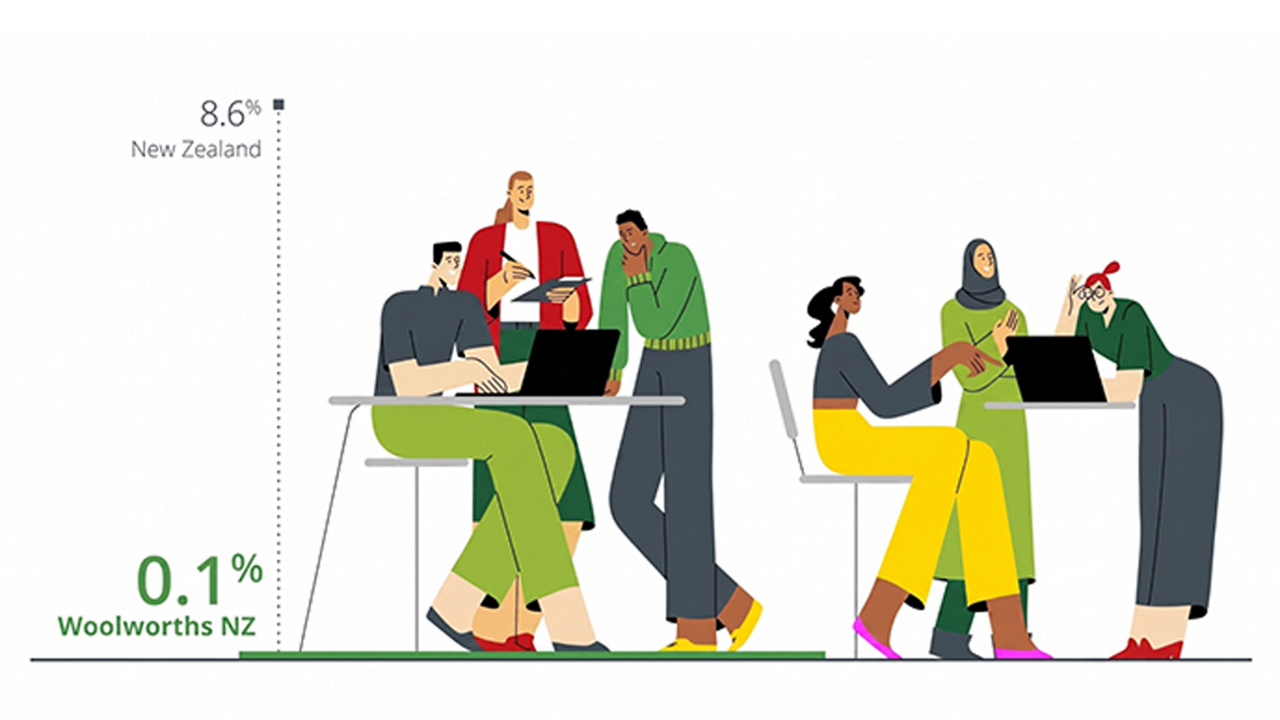
Another way to measure our progress is tracking differences in pay between women and men at Woolworths NZ. We started in 2018 by analysing gender pay parity. This looks at whether women and men in the same or equivalent roles receive equal pay. We’ve continued to see decreases in the pay parity gap across our business, with the parity gap now at 0% for like-for-like roles.
A key way we reduce the parity gap is through a remuneration governance process. This is where roles and their pay range are assessed by comparing them to other similar roles, both internally and externally, when they are established. Then, an annual pay parity review is also carried out.
Gender pay gap analysis
Gender pay gap analysis
But pay parity is not the full story. Since 2022, we analyse our gender pay gap - the gap between the median earnings of women compared with men. We use the Stats NZ methodology, which compares median base hourly rates.
There are many reasons people receive different pay, like seniority, length of service, or the responsibilities of the role. Analysing the gender pay gap helps identify whether gender is also playing a part. This could be through factors like:
- Unequal distribution of gender at different levels of an organisation
- Women and men not progressing at the same pace (taking career breaks, parental breaks etc)
- Differences in personal and professional options for education, occupation and family responsibilities
- Unconscious and conscious bias
Career level gender pay gap

Team Member and Team Leader/Specialist
Women and men are paid equally within these categories.

Manager
Male managers are paid 3.8% more on average than female managers.

Senior Leader
Male senior leaders are paid 7.5% more on average than female senior leaders.

Director
Male directors are paid 10.9% more on average than female directors.
Our gender pay gap
We’re pleased that, over a three year journey toward total pay equity, we have successfully closed our median gender pay gap from 1.4% in FY24 to 0.0% parity in FY25. This demonstrates the value of continued focus.
The operational structure of our organisation does play a large part in our pay gap results with more than 80% of our ~21,000 team members receiving pay aligned to a collective agreement. This reduces our gap. However, we also analysed our gender pay gap by job level.
Our Career Level framework has six defined levels from Team Member through to Managing Director. Analysing by career level, we can see the gender pay gaps generally widened at the more senior levels, where there’s greater variation in roles and salaries - including many unique, one off roles.
Our next steps
Armed with these insights, we’ll keep working to reduce the gaps we see occurring at these senior levels - we’re pleased to have seen reductions in the gap at both senior leader and director level compared to last year. We’ll continue to run our Women in Leadership programme, designed for women in manager-level roles. We’re also investing in learning for our leaders and senior leaders.
We’re proud to be part of the MindTheGap registry that advocates for business reporting of gender pay gaps as a first step to reducing them. We’ll continue to explore opportunities to reduce ours, and share our progress.